
Tuesday Of the Twenty-Fourth Week In Ordinary Time
Compassion: The Language of God
Other Celebrations for this Day:
Liturgical Cycle: C | Lectionary Cycle: I
Introduction
St Paul writes to Timothy on people fit to be ministerial leaders in the Church: bishops, priests, and deacons. He presupposes that they are from the people and close to the people, as they still were in those days. Then, aside from having some leadership qualities, they must first of all be good Christians themselves, who are credible because they live as they teach. Then their word will be as mighty as that of Christ, who could raise the dead to life.
In today’s gospel, Luke tries to tell us that the time of salvation has come, for with Jesus, the blind begin to see, the deaf hear, the lame walk, and yes, the dead come back to life. With him, a new era has begun – God’s era. It is the era in which we live. Do we make it an era of resurrection and life, in which our hands that reach out raise up our neighbors above their miseries? Do we make it an era in which we bring dead love back to life in Christ?
Opening Prayer
Loving Father,
your Son Jesus Christ spoke a human language
and filled it with new meaning.
He put his fingers on people’s ears and lips
and they could hear and speak
words of life and goodness.
Continue in us the work of your Son.
Allow us to change with him
darkness into light, sadness into joy
and death into life,
that with him we may also enter
your life and joy that last for ever.
First Reading
Different Categories
If someone aspires to the office of bishop desires a noble task.
Therefore, a bishop must be above reproach, married only once, responsible, prudent, well-mannered, hospitable, and skilled in teaching.
He must not be addicted to wine, quarrelsome, but gentle and peaceful, and not greedy for money,
but a man whose household is well-managed, with obedient and well-mannered children;
for if a man cannot manage his own household, how can he lead God’s church?
He must not be a recent convert, lest he become prideful and fall into the condemnation as the devil.
Furthermore, he must have a good reputation among outsiders, so that he does not fall into the trap of the devil.
Deacons, likewise, must be dignified and sincere, and moderate in drinking wine, not greedy for money;
they must hold fast the mystery of faith with a clear conscience.
Let them be tested first; if they are blameless, they may be accepted as deacons.
In the same way, women must be honest, not gossiping, but reserved and trustworthy.
Deacons may be married only once and must know how to guide their children and household well.
Those who serve well as deacons will gain honorable standing, with the authority to speak about the Christian faith.
Responsorial Psalm
Psalm 101:1b-2ab, 2cd-3ab, 5, 6
R. I will walk with a blameless heart.
Of mercy and judgment I will sing;
to you, O LORD, I will sing praise.
I will persevere in the way of integrity;
when will you come to me?
R. I will walk with a blameless heart.
I will walk with blameless heart,
within my house;
I will not set before my eyes
any base thing.
R. I will walk with a blameless heart.
Whoever slanders his neighbor in secret,
him will I destroy.
The man of haughty eyes and puffed up heart
I will not endure.
R. I will walk with a blameless heart.
My eyes are upon the faithful of the land,
that they may dwell with me.
He who walks in the way of integrity
shall be in my service.
R. I will walk with a blameless heart.
Alleluia Verse
R. Alleluia, alleluia.
A great prophet has arisen in our midst
and God has visited his people.
R. Alleluia, alleluia.
Gospel
When she saw him, the Lord took pity on her and said:
“Stop crying.”
Then he approached, touched the stretcher, and the men carrying it stopped.
Jesus then said:
“Young man, I say to you, wake up!”
A holy awe came over everyone, and they praised God, saying:
This news spread throughout Judea and the surrounding regions.
Prayers of the Faithful
– God of mercy and compassion, keep your Church forgiving and patient with its members who err or rebel, we pray:
– God of the sad and the sorrowing, fill us with Christian empathy for those who suffer and make us bold enough to tell them: “Do not weep. The Lord loves you,” we pray:
– God of those who are sick in any way, bring your healing power to them through people who visit them and cheer them up, we pray:
Prayer over the Gifts
God, your gifts to us of bread and wine
enable us to live and to enjoy life.
We bring them before you to fill them
with the higher life and the deeper joy
of your Son Jesus Christ.
Let them be a life and a joy
which, even in the uncertainties
and the trials of life,
can never be taken away from us.
Let him lead us to your everlasting life and joy.
We ask this in the name of Jesus the Lord.
Prayer after Communion
Faithful God,
you promise us life and joy
if we have the courage
to listen to Jesus’ words
and put them into practice.
Let your Son fill us here
with a love that is stronger than death,
that we may speak words that uplift
and that we can break for one another
bread that gives life.
Grant us this in the name of Jesus the Lord.
Blessing
Young man, young woman, I tell you, get up. Let us speak these words also to people who are suffering and discouraged, for they are words of life and resurrection. May almighty God bless you, the Father, and the Son, and the Holy Spirit.
REFLECTIONS
Nothing in the gospel narrative suggests that anyone asked Jesus to raise the son of the widow. This is one of the rare occasions wherein Jesus takes the initiative, without being asked by anyone, to heal or raise someone to life. What moved him to do so? I wonder if the scene provoked in him the future scenario of his own mother at his death: Here is a widow, just like his mother. She has lost the only son – Jesus’ own mother would lose her only son. I wish to think that Mother Mary was present with Jesus at Naim (or the disciples narrated it to her later) and the scene would be etched in her heart; and when her turn came to be the widow who lost her only son, she would recall the scene and find consolation and hope. What greater gift can a son leave for his mother than the assurance that she would have him again, alive!
17 September 2024
Do not weep
"The Lord was moved with compassion," says the Gospel today while describing his encounter with the widow of Naim, who was burying his only son.
Pope Francis emphasises the importance of moving beyond mere sympathy to true compassion. He explains that while it is natural to feel sympathy for others in need, true compassion involves actively getting involved in their problems. Our feeling of sympathy should lead us to be compassionate. For instance, when faced with a hungry crowd, Jesus didn't just sympathise with them but took charge and instructed the disciples to feed them. This serves as a powerful reminder for all of us to engage with and support those in need rather than turning away from their struggles.
Compassion enables a clear perception of reality, acting as the lens of the heart. Pope Francis explains that compassion is both a vulnerability and a strength of God. Compassion is the divine language, while the human language often reflects indifference. When someone in need approaches us for help, our typical response is to avert our gaze and walk away, illustrating our indifference.
In today's Gospel, Jesus comforts the mother by telling her not to cry. It's a tender display of empathy as Jesus reaches out and touches the stretcher. The widow of Naim and her deceased only son could symbolize Jesus himself and his mother, Mary. As a widow, Mary would also mourn the loss of her only son. In that moment, the Lord offers his comfort: "Do not weep."
Jesus was deeply moved. After the resurrection, Jesus would repeat these words to Mary Magdalene: "Do not weep!" In today’s Gospel we read that after raising dead man to life, Jesus "handed him over" to his mother as the best gift. Jesus’ actions deeply affect people. Who could this be? Feeling God's presence is both awe-inspiring and filled with grace.
16 September 2025
Luke 7: 11-17
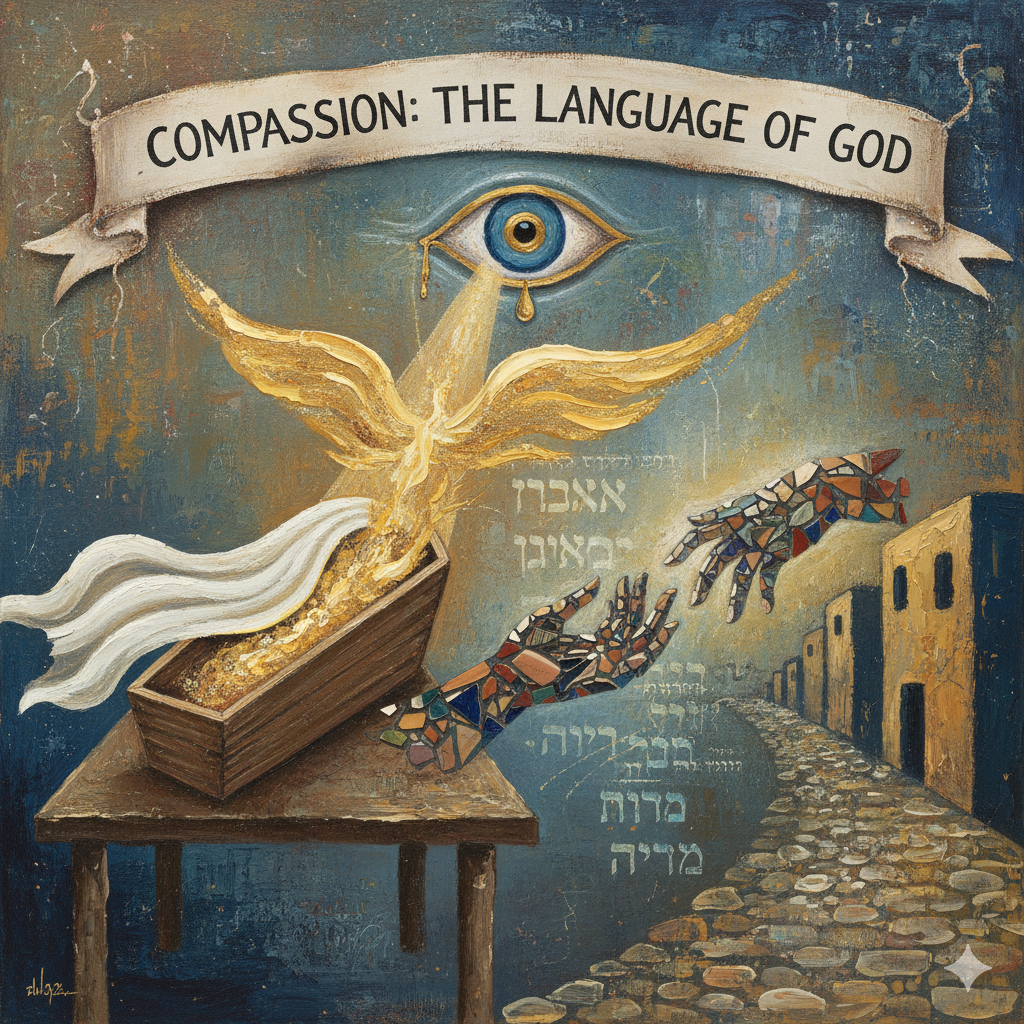
Compassion: The Language of God
In today’s Gospel (Luke 7:11-17), Jesus enters the little town of Nain, a day’s journey from Capernaum. Nain lies between Endor and Shunem—the very place where the prophet Elisha once raised another mother’s son (2 Kings 4:18-37). Even today, just outside Nain, a cemetery of rock tombs reminds us of the sorrow and finality of death. It is here, amid this landscape of grief, that one of the most beautiful stories of the Gospel unfolds.
A widow follows the coffin of her only son. In those few words—“He was his mother’s only son, and she was a widow”—all the pathos of human life is contained. The funeral procession, with flutes and cries of mourners, mirrors the timeless sorrow of humanity. Yet in the midst of this grief, the evangelist tells us: “The Lord was moved with compassion.” The Son of God allows His heart to be pierced by the tears of a mother. This is the God we believe in—the God who suffers with us.
Jesus approaches, touches the container—likely not a coffin, but a wicker basket—and commands life to return. As one commentator beautifully says: “Jesus claimed as His own what death had seized as its prey.” The truth remains: Jesus restored him to his mother. He showed that He is Lord not only of life, but also of death. He has triumphed over the grave and promises us: “Because I live, you also will live” (John 14:19). One little note to ponder here is: Was Jesus talking about himself and his mother, a widow who would lose his only son and moved with compassion, he brings her Son back to life?
Compassion is the lens of God’s heart, the language of His love. Indifference looks away; compassion steps forward. Jesus did not avoid the tears of the widow—He entered into them. May we, too, allow our hearts to be moved, to touch the suffering of others, and to speak the language of God: the language that restores life.