
Solemnity of the Most Sacred Heart of Jesus
Friday of the Second Week after Pentecost - God Loved Us First
Liturgical Cycle: A, B, C | Lectionary Cycle: I, II
Introduction
Greeting (See second reading)
God loved us before we could love him.
He sent us his Son as our Saviour
and let us share in his Holy Spirit.
May this love always be with you. R/ And also be with you.
Introduction by the Celebrant
When we celebrate the feast of the Sacred Heart or whenever we honour the Heart of Jesus, we celebrate the love of God that he showed us in his Son. On his own initiative, God, the source and origin of all genuine love, seeks us out and gives himself to us. Who are open to his love? Not the self-satisfied and the self-sufficient, for they don’t need God or people. They cannot accept love. But the weak and the humble can: they are aware of the poverty of their love; they know that they are vulnerable and fragile. God seeks our response of love. This answer must necessarily include that we show to those around us a bit of the warmth of God’s love. We should let people come to us as Christ let them come to him to lighten their burden.
Penitential Act
How much are we open to God’s love?
How much are we willing
to give love to others and receive it from them?
Before celebrating this Eucharist
let us ask these questions
in the presence of God and of one another.
(pause)
Lord, we are often so full of ourselves
that we pay no attention to your love.
Lord, have mercy. R/ Lord, have mercy.
Christ, we somehow feel annoyed
when people try to help us,
for it reminds us that we are not self-sufficient.
Christ, have mercy. R/ Christ, have mercy.
Lord, we often have no time for people
because we have no time for you.
Lord, have mercy. R/ Lord, have mercy.
May almighty God have mercy on us,
forgive us our sins against love,
and bring us to everlasting life. R/ Amen.
Opening Prayer
Let us thank God our Father
for the love he has shown us
In the heart of his Son
(pause)
God with a heart,
you have made your love visible
in your Son, a man like us except for sin,
and through him
you have bound yourself to us
by a bond of faithful love.
Accept our thanks
and help us to reflect a bit on your own love,
that like you and Jesus we may not be afraid
of showing affection and concern
and of rendering generous service
even if it is inconvenient to do so.
We ask you this through Christ our Lord.
First Reading
God’s Initiative of Love: This is the basic truth: the initiative of love comes from God. His love is gratuitous and faithful. The people of God are called to give a grateful and free response of love to God.
You are a people consecrated to the Lord, your God. The Lord has chosen you from among all the peoples on the face of the earth, that you may be his people.
Divine Gratuitousness and Israel’s Responsibility
It was not because you are more numerous than all the peoples that the Lord set his heart on you and chose you; for you are really the smallest of all peoples.
Rather, he has chosen you because of his love for you and to fulfill his oath to your fathers. Therefore, with a firm hand, the Lord brought you out from slavery in Egypt, from the power of Pharaoh.
So know that the Lord, your God, is the true and faithful God. He keeps his covenant, and his love reaches the thousandth generation for those who love him and fulfill his commandments.
But he punishes those who hate him in their persons and repays them without delay.
So keep the commandments, the norms, and the laws that today I command you to practice.
Responsorial Psalm
Psalm 103:1-2, 3-4, 6-7, 8, 10
R. (cf. 17) The Lord's kindness is everlasting to those who fear him.
Bless the LORD, O my soul;
all my being, bless his holy name.
Bless the LORD, O my soul;
and forget not all his benefits.
R. The Lord's kindness is everlasting to those who fear him.
He pardons all your iniquities,
heals all your ills.
He redeems your life from destruction,
crowns you with kindness and compassion.
R. The Lord's kindness is everlasting to those who fear him.
Merciful and gracious is the LORD,
slow to anger and abounding in kindness.
Not according to our sins does he deal with us,
nor does he requite us according to our crimes.
R. The Lord's kindness is everlasting to those who fear him.
Second Reading
God Loved Us First: John’s first letter echoes and deepens the Old Testament message: All love comes from God, for God is love. His love commits us to one another. If we do not love one another, God’s love cannot be in us.
God Is Love
Beloved, let us love one another because love comes from God. Everyone who loves is born of God and knows God.
Those who do not love have not known God, for God is love.
How has the love of God appeared among us? God sent his only Son into the world so that we might have life through him.
This is love: not that we loved God, but that he loved us first and sent his Son as an atoning sacrifice for our sins.
Beloved, if God’s love has been shown to us, we also ought to love one another.
No one has ever seen God, but if we love one another, God lives in us, and his love is made complete in us.
How can we know that we live in God and he in us? Because he has given us his Spirit.
Moreover, we have seen and testify that the Father sent his Son as savior of the world.
Whoever acknowledges that Jesus is the Son of God, God lives in them and they in God.
We have come to know and rely on the love God has for us. God is love. Whoever lives in love lives in God, and God in them.
Alleluia Verse
R. Alleluia, alleluia.
Take my yoke upon you, says the Lord;
and learn from me, for I am meek and humble of heart.
R. Alleluia, alleluia.
Gospel
Only the Humble Are Open to the Humble Jesus: Who understands and accepts Jesus and his good news of love? Not the self-sufficient and the proud, who rely on their own achievements, but the humble, who are aware of the poverty of their own hearts.
The Father and the Son
At that time, Jesus said:
“Father, LORD of heaven and earth, I praise you because you have hidden these things from the wise and learned, and revealed them to simple people.
Yes, Father, this was your gracious will.
Everything has been entrusted to me by my Father. No one knows the Son except the Father, and no one knows the Father except the Son and those to whom the Son chooses to reveal him.
Come to me, all you who are weary and burdened, and I will give you rest.
Take my yoke upon you and learn from me, for I am gentle and humble of heart; and you will find rest for your selves.
For my yoke is easy and my burden is light.”
Prayers of the Faithful
Let us pray to our Lord Jesus Christ, to whose dedicated love there are no limits, and let us say: R/ Lord, keep us in your love.
– Lord, we pray you for your Church. Let it be a community where people find one another and commit themselves to one another, we pray: R/ Lord, keep us in your love.
– Lord, we pray you for all those whose task it is to proclaim your gospel. May they speak your word as good news of love and joy for all people, we pray: R/ Lord, keep us in your love.
– Lord, we pray you for all those who are lonely and lack direction in life. May they encounter people who bring them light and love, we pray: R/ Lord, keep us in your love.
– Lord, we pray you for all those who have shut up themselves within walls of superiority, pride or hatred. Touch them with your Spirit of love, that they may become open again to people and learn again to appreciate, serve and love, we pray: R/ Lord, keep us in your love.
– Lord, we pray you for our families, that all those living under the same roof may share each other’s joys and sorrows, be patient with one another and live for one another, we pray: R/ Lord, keep us in your love.
Hear our prayer, Lord, and give us a heart for one another, that we may build community and live in your love, now and for ever. R/ Amen.
Prayer over the Gifts
Lord our God,
Your son Jesus gave himself totally for you
And he gives himself now to us
in this Eucharistic celebration.
May we learn from him
to help others carry their burdens
and to bring out the best in them,
and may our love be
as faithful and gratuitous as his,
that he may live among us
now and for ever.
Introduction to the Eucharistic Prayer
It is a grace for us that we can join Jesus our Lord in gratitude to the Father for all God’s love.
Introduction to the Lord’s Prayer
Let us pray to God our Father,
the source and power of all love,
in the words of Jesus our Lord: R/ Our Father…
Deliver Us
Deliver us, Lord, from every evil
and keep us free from sin
by which we refuse to give you
a response of grateful love.
Give us the peace that comes
from living in your friendship
and help us to work steadily
for the growth of your kingdom
of love and justice,
that we may prepare the full coming among us
of our Lord and Savior Jesus Christ. R/ For the kingdom…
Invitation to Communion
This is Jesus the Lord,
the Son of the living and loving God,
who showed us how much God loves us.
Through him, we have come to believe
that God is near to us.
Happy are we to receive him. R/ Lord, I am not worthy…
Prayer after Communion
Lord our God,
Your love beats in a human heart
When your Son lived among people
and was one of us.
Help us to become one with him
and give us hearts as wise as his.
And may we prefer, as he did,
those who are loved least
and therefore need it most,
that we may bring to them a bit of your warmth
and love in them him who is our Lord
now and forever. R/ Amen.
Blessing
As God loved us before we could love him, let our Christian living be a hymn of gratitude to his initiative of love. Let us ask God to bless us and to fill the poverty of our love. May the God of love bless you all: the Father who is the source of love, the Son who lived love unto death, the Spirit who makes love perfect. R/ Amen.
Let us go in peace to make God’s love visible in this world, that we may truly know and love God. R/ Thanks be to God.
REFLECTIONS
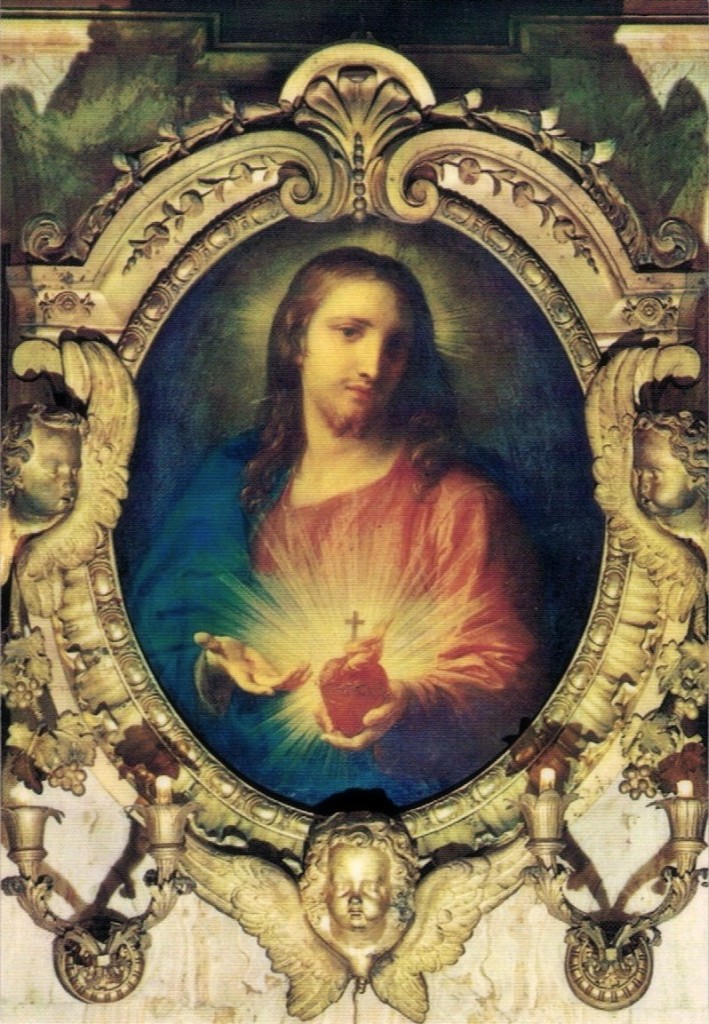
Explanation of the image of the Sacred Heart of Jesus:
Pompeo Batoni (1708-1787) is the painter who depicted the most famous image of the Sacred Heart of Jesus.
In 1760, Batoni painted the Sacred Heart of Jesus, which was placed in a Chapel in the Jesuit Church of the Gesù in Rome. This work became the official image for the popular devotion to the Sacred Heart of Jesus.
The painting of the Sacred Heart of Jesus was inspired by the apparition of Jesus, under the title of the Sacred Heart, to St Margaret Mary Alacoque (1647-1690). In 1673, on the Feast of St. John the Evangelist, Our Lord came to St. Margaret Mary, while she was in prayer before the Blessed Sacrament. The saint describes His Sacred Heart with the following words: “The Divine Heart was presented to me in a throne of flames, more resplendent than a sun, transparent as crystal, with this adorable wound. And it was surrounded with a crown of thorns, signifying the punctures made in it by our sins, and a cross above signifying that from the first instant of His Incarnation, […] the cross was implanted into it […].”
St Margaret’s account continues with the words that Jesus said to her, “My Divine Heart is so inflamed with love for men, and for thee in particular that, being unable any longer to contain within Itself the flames of Its burning charity, It needs to spread them abroad by thy means, and manifest itself to them (mankind) in order to enrich them with the precious treasures which I discover to thee, and with contain graces of sanctification and salvation necessary to withdraw them from the abyss of perdition. I have chosen thee as an abyss of unworthiness and ignorance for the accomplishment of this great design, in order that everything may be done by Me.” Jesus asked Margaret to place her head on His breast, asking her to give Him the gift of her small heart to be placed in the furnace of His Divine Heart, before returning to her, inflamed by His love.
========
Mathew 11: 25-30
Gentle and humble of Heart
Devotion to the Sacred Heart has very ancient origins. It has spread in the church, especially starting in the seventeenth century, through the work of a French mystic, St. Margaret Mary Alacoque, in 1673. In her autobiography, this Visitation sister tells of the revelations she had. She refers to the famous Twelve Promises of the Sacred Heart, from which the pious practice of the nine first Fridays of the month derives. It is from the inspiration of this saint that the Feast of the Sacred Heart was established. In 1856, Pope Pius IX raised the feast to the rank of a solemnity in the Universal Church, celebrated on the Friday after the Solemnity of Corpus Christi. On 11 June 1899, Pope Leo XIII consecrated humanity to the Most Sacred Heart of Jesus.
As we celebrate Jesus’ heart today, we are invited to stay close to his heart as John the evangelist did at the Last Supper, so that we hear from him words of consolation, hope, and forgiveness at all times.
Chapter 11 of Matthew’s Gospel speaks of the consolation and comfort the Lord brings to distressed people. Matthew presents how Jesus confronted such apparent failures in life: John the Baptist doubted him, and the religious leaders rejected him and his message. But Jesus rejoices for what happened and says: “Father, Lord of heaven and earth, I praise you because you have hidden these things from the wise and learned and revealed them to simple people” (v. 25).
The poor, the humble, and the marginalised were the first to welcome his liberating word. It is the small ones, more than any other, that need God’s tenderness. The Jewish law - the Torah - was a yoke meant to guide the faithful on the right path. But, for the people, this yoke was too heavy a burden.
To these poor, lost and disoriented people, Jesus offered them freedom from fear and distress, which the rabbis instilled in them. Instead, Jesus recommended: Accept my law, the single commandment of love, because in God’s heart, there is only love. The yoke of Christ is easy, and his burden is light because he does not impose it on people; instead, he carries it first.
“Learn from me for I am meek and humble of heart” (v. 29). “Meek and humble of heart” are the terms that we find in the Beatitudes. They refer to the poor and oppressed but do not resort to violence. He has a meek heart because he made himself small; he chose the last place, and put himself at the service of people and assumed the attitude of a slave.
This Gospel passage invites us to make a choice: Which God do we believe? Do I believe in a God with a merciful heart or a God with a stiff legalist heart?