
Twenty-Sixth Sunday in Ordinary Time
Seeing the Poor at Our Door
Liturgical Cycle: C | Lectionary Cycle: I
Introduction
Open Your Eyes
Bridging the Gap between Rich and Poor
Greeting (See Second Reading)
Blessed be our Lord Jesus Christ:
to him be honor and everlasting power.
May his grace and peace
be always with you. R/ And also with you.
Open Your Eyes
How come that we are so little aware of the misery, poverty, discrimination, injustice around us? Is it because we have not learned to see, or that we prefer not to see? It is said of God in the Old Testament that he saw the misery of his people, and, seeing it, he liberated them. Jesus saw the misery of the people around him and he did all he could to free them. Let us ask the Lord here with us that we may learn to see our own afflictions and those of the people around us. Then we can, with God’s help, do something to remedy them.
Bridging the Gap between Rich and Poor
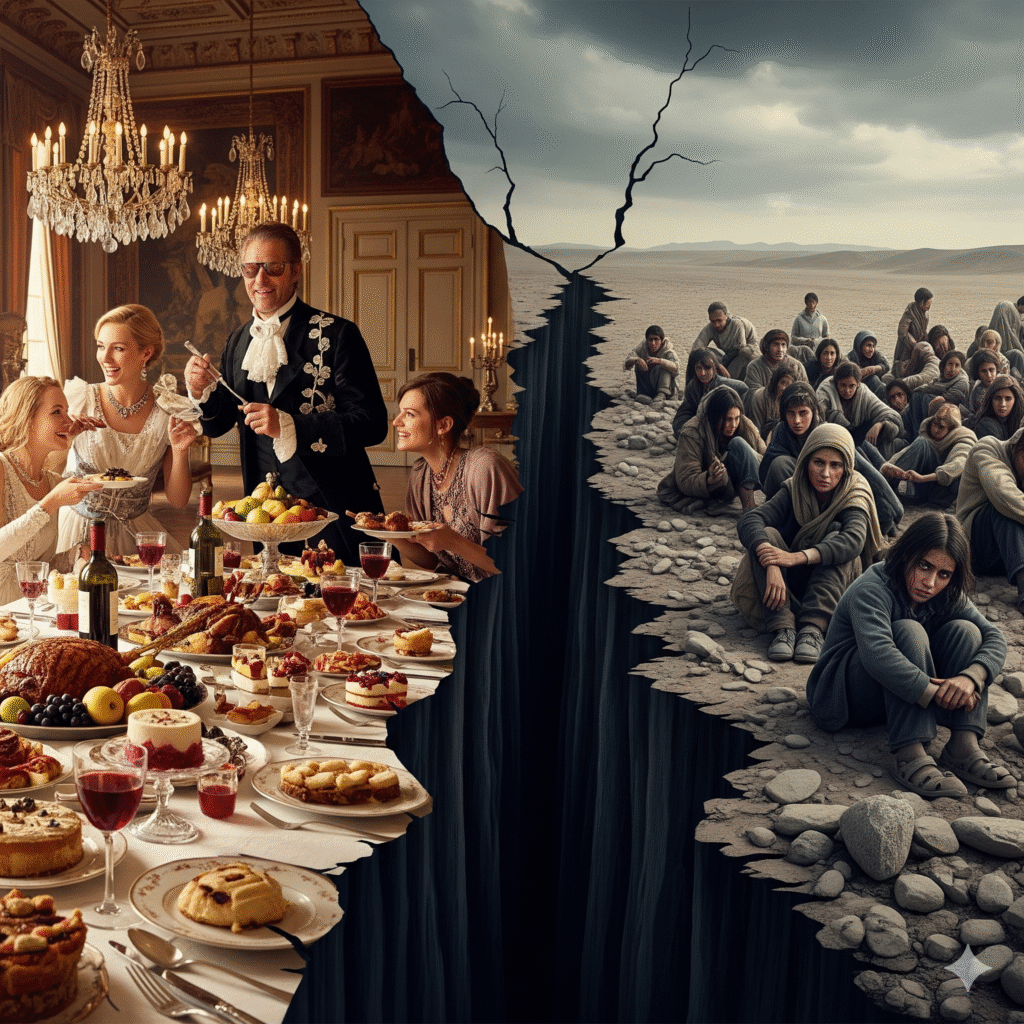
We know that in our country and elsewhere—in fact, in large parts of the world—there is a wide gap between the rich and the poor. Many ask themselves, hopefully we too, “What can I do about all this misery? My means are very limited, and I cannot carry the burden of the world.” But we know what the gospel asks of us. If all contribute, each in his or her own place, their share toward solving the problems of poverty, need, and suffering, how much better our whole world would become and how much nearer the kingdom! We need no angel to come and tell us. Listen to the message of the Lord himself.
Penitential Act
Blind as we are to our faults and to the needs of people
let us ask the Lord to forgive us and to open our eyes.
(pause)
Lord Jesus, you saw in the eyes of sinners
their hunger for acceptance and forgiveness:
Lord, have mercy. R/ Lord, have mercy.
Jesus Christ, you saw the silent need of the poor
to share in the life of the community:
Christ, have mercy. R/ Christ, have mercy.
Lord Jesus, you saw the need
of the sheep without shepherds
for someone to follow and to believe in:
Lord, have mercy. R/ Lord, have mercy.
Take our sins away, Lord,
and open our eyes to compassion and love.
Lead us to everlasting life. R/ Amen.
Opening Prayer
Let us pray to God
for compassionate and generous hearts
(pause)
Our generous and loving God,
your Son Jesus is risen from the dead
and tells us to see the needs of the poor
and to give them food and drink.
In them, may we recognize your Son
and love him and care for him.
You have filled us with good things,
all free of charge.
Make us poor of heart, that we may understand the poor,
generous enough not to measure our gifts,
and grateful for all you have given us
by bringing joy and liberation to the needy.
We ask this in the name of Jesus the Lord. R/ Amen.
First Reading
The Rich Will Be Made Poor
The prophet Amos rings out God’s indignation over the insensitive rich. They enjoy life without any concern for the poor. God cannot accept that any person or community would tolerate such inequality and indifference.
Third Woe: Luxury and Riches
Woe to those proud people who live overconfidently on the hill of Samaria!Woe to you, men of renown, from the first among the nations, to whom the people of Israel come!
You lie on beds inlaid with ivory and sprawl on your couches; you eat lamb from the flock and veal from calves fattened in the stall.
You strum your harps, and like David, experiment with new musical instruments.
You drink wine by the bowlful and anoint yourselves with the finest oils, but you do not mourn the ruins of Joseph.
Therefore, you will be the first to go into exile, and the feast of sprawlers will come to an end.
Responsorial Psalm
R. Praise the Lord, my soul!
or:
R. Alleluia.
Blessed is he who keeps faith forever,
secures justice for the oppressed,
gives food to the hungry.
The LORD sets captives free.
R. Praise the Lord, my soul!
or:
R. Alleluia.
The LORD gives sight to the blind;
the LORD raises up those who were bowed down.
The LORD loves the just;
the LORD protects strangers.
R. Praise the Lord, my soul!
or:
R. Alleluia.
The fatherless and the widow he sustains,
but the way of the wicked he thwarts.
The LORD shall reign forever;
your God, O Zion, through all generations. Alleluia.
R. Praise the Lord, my soul!
or:
R. Alleluia.
Second Reading
Witnessing to Christ with Our Lives
Christians, especially community leaders, must bear witness to the Father and to Jesus through their Christian living, for they owe to God their salvation in Jesus Christ.
Instructions to Timothy
But you, man of God, avoid all this. Aim to be holy and godly. Live with faith and love, along with patience and kindness.
Fight the good fight of the faith and win everlasting life, to which you were called when you made the good profession of faith in the presence of many witnesses.
In the presence of God, who gives life to all things, and of Jesus Christ, who expressed before Pontius Pilate the authentic profession of faith:
preserve the message revealed to everyone. Keep yourself pure and blameless until the glorious coming of Christ Jesus, our Lord,
whom God will bring about at the proper time, the blessed and only ruler, King of kings and Lord of lords.
To him, alone immortal, who lives in unapproachable light, and whom no one has ever seen or can see, be honor and eternal power. Amen!
Alleluia Verse
R. Alleluia, alleluia.
Though our Lord Jesus Christ was rich, he became poor,
so that by his poverty you might become rich.
R. Alleluia, alleluia.
Gospel
God Will Make the Poor Rich
The rich man of the parable is unconcerned about the poor man. But God’s justice reverses the situation: the poor will become rich before God, the selfish will lose everything.
Once there was a wealthy man who wore purple and fine linen and feasted daily.
Lazarus, a poor man covered with sores, lay at his gate,
longing to eat the scraps that fell from the rich man’s table. Even dogs used to come and lick his sores.
The poor man died, and the angels took him to be with Abraham. The rich man also died and was buried.
From the torment of the netherworld, he looked up and saw Abraham far off, with Lazarus resting beside him.
He called out:
‘Father Abraham, have mercy on me and send Lazarus, with the tip of his finger dipped in water, to cool my tongue, for I am suffering greatly in this fire!’
Abraham replied:
‘My son, remember that in your lifetime you were prosperous, while Lazarus’s situation was unfortunate. Now he is comforted, and you are suffering.
But that’s not all. Between your place and ours, a great chasm has been fixed, so that no one can cross from here to there or from there to here.’
The rich man pleaded again:
‘Then I beg you, Father Abraham, send Lazarus to my father’s house
where my five brothers live. Let him warn them so they won’t end up in this place of torment.’
Abraham replied:
‘They have Moses and the prophets. Let them listen to them.’
But the rich man said:
‘No, Father Abraham; if someone from the dead goes to them, they will repent.’
Abraham said:
‘If they will not listen to Moses and the prophets, they will not be convinced, even if someone rises from the dead.’”
Prayers of the Faithful
Let us pray to our loving Father, the protector of widows and orphans and the support of the humble and of strangers. Let us pray: R/ Lord, hear our prayer.
– For a prophetic voice for the Church, that it may not tolerate the poor to be trampled upon or to be silenced, let us pray: R/ Lord, hear our prayer.
– For open minds for the leaders of nations, that all the money wasted on weapons of destruction may be used for the welfare of people, let us pray: R/ Lord, hear our prayer.
– For open hands to all who extend theirs, whether in friendship or as an appeal for help, that we may welcome them and fill them, let us pray: R/ Lord, hear our prayer.
– For open hearts to all loneliness, to all fear and bitterness, that we may respond by becoming healers in the name of the Lord, let us pray: R/ Lord, hear our prayer.
– For open eyes toward the humble and the little ones, that we may respect and restore their dignity as human beings and children of the Father in heaven, let us pray: R/ Lord, hear our prayer.
– For communities in which the rich care for the poor and the poor teach the rich how to be patient and dependent on God, let us pray: R/ Lord, hear our prayer.
God our Father, help us to use the goods of this earth to bridge the gap between rich and poor, for we are all your sons and daughters, now and for ever. R/ Amen.
Prayer over the Gifts
Our God and Father,
here are bread and wine,
simple food and the drink of joy.
By this gesture of offering
we assume our responsibility for the poor.
With your Son, let us never remain indifferent
to the human and spiritual misery
of our brothers and sisters in need.
Accept the poverty of our own hearts
and be our only lasting riches,
through Jesus Christ our Lord. R/ Amen.
Introduction to the Eucharistic Prayer
Let us praise the Father with Jesus for showing us his compassion through his Son. May he give us a lively and warm concern for our brothers and sisters in need.
Introduction to the Lord’s Prayer
Recognizing that we are all poor
before our Father in heaven,
we pray to him with all trust
the prayer of Jesus, his Son: R/ Our Father...
Deliver Us
Deliver us, Lord, from all selfishness
that closes our hearts and hands
to the needs of the people around us.
Keep us from becoming enslaved
by the things we have, even by our talents.
Help us to free your people from want and fear
with the gifts of our minds, hearts,
and with material goods,
that we may prepare for the full coming
of our Lord and Savior Jesus Christ. R/ For the kingdom...
Invitation to Communion
This is Jesus our Lord. He invites us to share his meal and to learn from him to share what we are and have. Happy are we to be invited to his supper.
R/ Lord, I am not worthy...
Prayer after Communion
God, Father of the poor,
your Son has been here among us
and he has knocked on the door of our hearts.
We have welcomed him,
but it was he who gave us to eat.
May we keep receiving him
and making him feel comfortable as our brother
every time someone begs for our help
or, when in need, is too timid
to express where it hurts.
We ask you for this sensitivity
through Jesus Christ our Lord. R/ Amen.
Blessing
In this Eucharistic celebration
the Lord has enriched us with his word
and with the gift of himself.
His bread of life tasted better
because it was shared.
We are now ready to enrich one another
and to make our happiness greater
by sharing it,
with the blessing of almighty God,
the Father, and the Son, and the Holy Spirit. R/ Amen.
Go in peace to love and serve the Lord
in one another.
R/ Thanks be to God.
REFLECTIONS
28 September 2025
In today’s Gospel, Jesus tells us the parable about two men: one rich, one poor. The rich man is not described as wicked, dishonest, or immoral. He is simply “a rich man.” At his gate lay Lazarus, poor and sick, longing to eat the scraps that fell from the rich man’s table. The dogs were his only companions.
Jesus gives the poor man a name—Lazarus, meaning “God is my help.” But the rich man remains nameless. To be without a name was to be nobody, erased from memory. Jesus is teaching us that before God, it is not wealth or power that gives us dignity. God knows the name of the poor, and in them he reveals his presence.
The rich man’s only sin was his indifference. He was so absorbed in his comfort, in appearances, in the admiration of others, that he did not notice the suffering of the man at his door. The great danger of wealth is that it blinds us, seduces us, makes us believe we are self-sufficient, and closes our eyes to the needs of others.
For many in today’s world, money becomes an idol, a false god, “mammon,” that replaces the living God. We begin to live for appearances rather than for truth.
The parable continues with a reversal: Lazarus, who suffered, is carried to Abraham’s side, while the rich man finds himself in torment. Jesus is not giving us a description of the afterlife but using powerful images to shake us. The torment of the rich man is that he finally lifts his eyes and sees the poor man he had ignored. He realises too late that the abyss separating them was one he created during his life, by choosing not to share.
This abyss, the gulf between rich and poor, is enormous in our society today. Some feast while others starve. Some spend extravagantly on luxuries, while others lack access to basic necessities like medicine, water, or shelter. This is not God’s plan.
Lazarus is now in Abraham’s bosom, not because he was virtuous or patient. The Gospel tells us nothing of his merits. Lazarus is there simply because God is on the side of the poor. “The Lord secures justice for the poor” (Ps 140). God identifies with those who are left out, with those forgotten at the gates of our comfort.
Brothers and sisters, this parable is not about the next life. It is about now. The time to cross the abyss, to close the distance between rich and poor, is today. The Gospel is urging us not to wait. If we hoard our gifts, they will slip through our fingers; if we share them, they become love, and love endures forever.
The question is simple but urgent: whom do we see? Do we see the poor outside our doors, in our cities, in our world? Do we see the migrants, the homeless, the elderly who live alone, the sick who cannot afford treatment, the children who hunger? Let us ask the Lord for the grace to open our eyes.
Intentions vs Actions
Read: Amos condemns those who live a luxurious life without a care for others. Paul exhorts Timothy to be pure and blameless before God. Jesus gives us the parable of Lazarus and the rich man, to remind us that we are indeed our brothers and sisters’ keepers.
Reflect: There is something noble about the rich man in today’s parable. He is languishing in the netherworld; but he has no attack of envy or fury, seeing Lazarus in heaven. He even knows Lazarus by name! Further, even when he is burning in hell, he thinks of his brothers and wants them to be spared of the same fate! If we were to meet this guy while he was alive on earth, he would definitely come across as gentle, caring, and courteous. He could even pass off as a diplomat in the United Nations, working for world peace! Yet, he has ended up in hell! Perhaps the lesson is this: None of our best intentions or chapter documents or wonderfully conceived sustainable developmental goals would suffice in the Kingdom: what is needed is concrete action on the ground, wiping the tears of the neighbors, caring for their needs.
Pray: Identify the needs of someone around you and pray for him/her.
Act: … and provide for him/her.
Reflection taken from Bible Diary 2022; written by Fr.Paulson Velyannoor, CMF